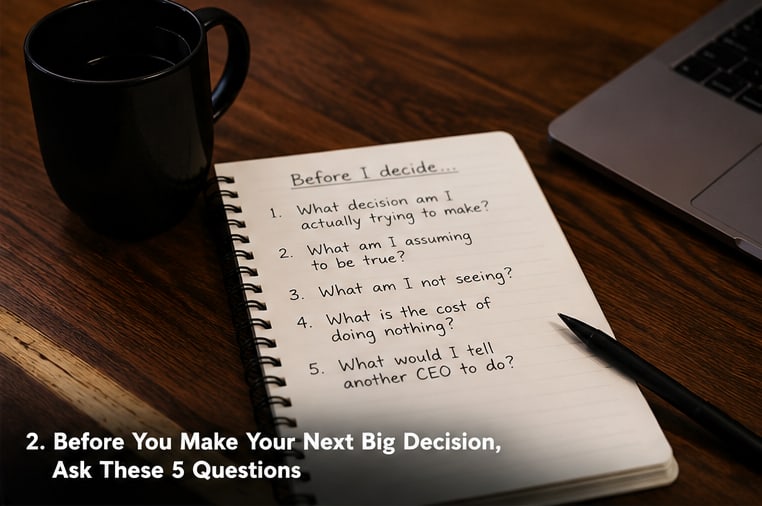

Before You Make Your Next Big Decision, Ask These 5 Questions
CEOs and business owners make decisions every day.
Most are relatively straightforward. Others can materially change the trajectory of the company.
- Do I replace a longtime executive?
- Should we make this acquisition?
- Is it time to expand?
- Should I promote this person?
- Do we make the technology investment?
- Should I sell the business?
The difficulty with decisions like these isn’t usually a lack of intelligence or experience.
It's that the person making the decision is also inside the problem.
We have history. Relationships. Assumptions. Emotions. Financial interests. Previous decisions we want to validate.
That makes it surprisingly difficult to see an issue objectively.
Before making your next important decision, try asking yourself these five questions.
1. What decision am I actually trying to make?
This sounds obvious, but leaders frequently begin solving a problem before clearly defining it.
“Sales are down” is not a decision.
“Should I replace my VP of Sales?” is.
Clarity about the actual decision changes the conversation.
2. What am I assuming to be true?
Every decision contains assumptions.
The employee will leave if I confront them.
Customers won’t pay a higher price.
Nobody else can do what I do.
We can't grow without adding people.
Write your assumptions down and ask:
Which of these do I actually know to be true?
3. What am I not seeing?
This may be the most valuable question of the five.
Ask someone who sees the world differently from you.
A good outside perspective often doesn't provide the answer. Instead, it exposes something you haven't considered.
4. What is the cost of doing nothing?
Leaders tend to focus on the risks associated with action.
What happens if the new hire doesn't work out?
What happens if the investment fails?
What happens if the customer leaves?
But maintaining the status quo is also a decision.
Ask what happens in six months or a year if nothing changes.
5. What would I tell another CEO to do?
Distance creates clarity.
Imagine another business owner described your exact situation to you.
What questions would you ask?
What would concern you?
What would you advise them to do?
It can be remarkable how clearly we see someone else’s problem compared with our own.
Better Questions Lead to Better Decisions
These five questions won't eliminate uncertainty. Leadership doesn't work that way.
But they can help expose assumptions, clarify tradeoffs, and slow down the natural tendency to jump from problem to solution.
They also demonstrate something I believe strongly:
CEOs don't necessarily need more advice. They need better perspective.
That's one of the fundamental ideas behind a CEO peer advisory group. Instead of working through an important decision entirely on your own, you can pressure test your thinking with experienced leaders who have no stake in the answer other than helping you make the best decision possible.
Think about the biggest decision on your desk right now.
Try the five questions.
If you'd like to learn how CEOs use peer advisory groups to work through decisions like these, email me at david.mazer@vistagechair.com
Next in this series: Who Can a CEO Talk to When They Can't Talk to Anyone Else?
Images